(Re) Engage Consulting
  • Home
  • About
    • An Open Letter
    • Process
    • Founder
    • Collaborators
  • Services
    • Individuals
    • Teams
    • Organizations
  • Blog
  • Let's Talk

WE ALL WANT TO
   LEAVE A MARK 

Bios with Bling

10/27/2015

1 Comment

 
Picture

What’s with job titles having so much bling these days?  

​Chief Happiness Officer

Conversation Architect
Jolly Good Fellow
Chief Weirdness Officer
People & Business Outcomes Enthusiast

Futurist and Organizational Alchemist

Chief Philosopher
 
Apparently the tradition Manager, Director, Vice President, Chief XYZ and President titles don’t cut it anymore.  Why are so many job titles being accessorized with new language?
 
We expect this descriptive flare from start-ups and tech companies because they always seem to be doing their own thing anyway.  It’s happening with Millennials too, as they exercise their stereotypical entitlement and wear their non-compliance  as a badge of honor.  What if this signals a shift in people's relationship to their work?  What if beefed up business cards and creative bios are among the first places where such a phenomenon becomes observable?

These new titles convey much more than job function and location within the organizational hierarchy -- they convey values.  
These titles reveal a desire to talk about
​ work in more meaningful ways.  
More and more people are using their titles as outlets for self-expression.  They don't just communicate what they do, but how they do it, and WHY they do it. 
 
I encountered a quote in grad school that comes to mind, reminding me that self-expression at work shouldn’t be surprising. In the classic book The Leadership Challenge, Kouzes & Posner suggest that leadership is built upon this foundation of self-expression.
“You cannot lead out of someone else’s experience.  You can lead only out of your own. 
Unless it’s your style and your words, it’s not you–it’s just an act.  People don’t follow your position or your technique, they follow 
you…you have a responsibility to your constituents to express yourself in an authentic manner, in a way they would immediately recognize as yours.” 

​A responsibility for self-expression at work? Really?  That seems a little out of step with the usual office norms. Is there a place for such luxuries in serious business? Many people think there is. Jobs aren’t just jobs anymore.  They are avenues for people to express their quirkiness while contributing their skills to the task at hand.  

People thoughtful enough to include 
the what, how and why of their work in a job title are precisely the ones I want in my organization.
My questions for you:
  • What does your current title say about you?
  • Consider a title change - try to include the what, how and why of your work in the new title

1 Comment

Useless Feedback

10/22/2015

0 Comments

 
Picture

​We've all experienced it.  A colleague raises a finger in your direction at the end of meeting, gesturing for you to hang back as everyone else leaves the room.  You gather your things and take a seat in the chair beside him and he says, "I'd like to give you some feedback."
 
One of two reactions typically occur: glee or fear.
Glee says ...
He finally noticed my work and is interested in my ideas!  
​Maybe he wants to bring me in on another project, or take me under his wing and help me move up in the company.  Today is the day my
 creativity and hard work
​will be noticed and rewarded.
Fear says ...
Wait, did I miss something?  Am I in trouble?  What's wrong?  
Am I not keeping pace?  Did I overstep somewhere?  
Did someone else send him to talk to me?  The second-guessing begins, leaving you to wonder about the merits of everything you've ever done.  
​
Lest you disregard this description as overly dramatic and sporadic, think about the literal usage of the word "feedback" in your organization.  Is this the term used when colleagues compliment each other?  Is it code that a promotion is likely on the way? Or is the term feedback more often used to begin conversations about sub-par performance?
This is precisely why feedback processes in organizations prove mostly useless.  
​Perhaps an unfamiliar voice in business circles, Julia Cameron's advice to artists about differentiating useful and useless critique is something organizations would be wise to consider. Cameron notes that feedback – or critique, in her words – is essential to growth and development and goes on to highlight the innate human ability to distinguish between the two.  She offers a simple litmus test to help identify which kind you might be dealing with:
"Useless criticism...leaves us with a feeling of being bludgeoned.  As a rule,
it is withering and shaming in tone; ambiguous in content; personal, inaccurate, or
blanket in it's condemnations.  ​There is nothing to be gleaned from irresponsible criticism."

​A lot of what masquerades as feedback in organizations today fits Cameron’s definition of useless. It's a good thing that she reminds us of a better way.
"Pointed criticism, if accurate, often gives...an inner sense of
​'Ah-hah! So that's what's wrong with it.'

​Useful criticism ultimately leaves us with one more puzzle piece for our work."

Read that last line again.
 
Useful feedback reveals resources.  It relieves dissonance.  It allows the giver and receiver to be momentary equals, standing in service to the project at hand. Useful feedback is unapologetically about the work, leaving egos to sit on the sidelines and fend for themselves. Useful feedback ultimately, well - helps.
 
My questions to you:
  • Is the feedback you give useful or useless?
  • When was the last time your feedback genuinely helped and produced tangible results?
0 Comments

The nature of tools...

10/14/2015

1 Comment

 
Picture

​Many remember the 2014 Time magazine cover that inserted mindfulness into the broader organizational conversation, posing questions about business practices that surprised more than a few companies. Since then, our exposure to mindfulness has grown as have the predictable emergence of groups identifying as adherents and skeptics of the idea.  I encountered someone in the latter category today and our conversation reminded me about the nature of tools.
 
Tools are designed for a purpose, to solve a particular problem or provide assistance for a specific task.   Wrenches tighten and loosen.  Saws cut.  Drills drive screws into objects so they can be joined securely to other objects.  But who hasn’t used a wrench, the handle of a screwdriver or even a shoe to pound a nail when a hammer wasn’t at hand? 

​Here’s the thing about tools: regardless of the original intention, it is the user who ultimately determines their use and purpose. 


The same is true of the advances in management theory and organizational best practices.
 
Emotional Intelligence hit the big-time in 1995. Gallup produced their StrengthsFinder research in 2001.  Holocracy  showed up in the mid 2000s. Mindfulness hit the broader scene with the Time article in 2014, and countless others have preceded these.  All of these schools of thought, leadership theories, coaching methodologies, organizational interventions, training programs etc. are tools - nothing more, nothing less. And all tools can - and have been - used constructively, creatively and harmfully, depending upon the user.

The usefulness - and harmfulness - of a tool
​lies in the hands of the user.  
​
My questions to you:
  • How are you using the tools available to you?  Are using the tool as it was intended or are you finding innovative ways to use traditional tools? 
  • What tools bring about the transformative change your organization needs?
1 Comment

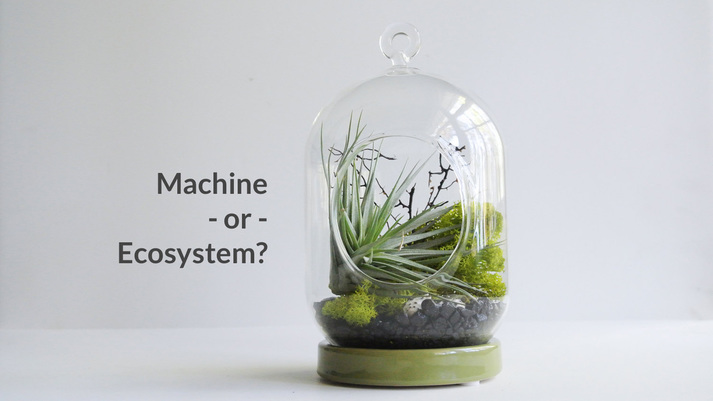
Machine or Ecosystem?

10/7/2015

1 Comment

 
Picture
photo credit
A growing contingent of management professionals believe a shift is coming to our workplaces, and it is nothing short of revolutionary.  After reading half the book that is predicting this shift, I'm already inclined to agree.  What's coming? Only the elimination of power hierarchy in exchange for self-managed teams on steroids - that's all. 

Frederic Laloux makes a number of refreshing claims in his 2014 release, Reinventing Organizations.  But first among them is his provision of an alternative metaphor to understand organizations and the ways in which human beings interact with them.
 
One of the more prevalent views likens organizations to machines, each having cogs, levers, inputs and outputs, and concentrating power among a select few individuals who are then responsible to flip the right switches to produce the right results. Laloux argues that viewing organizations this way has accompanying limits, and often leaves resources underutilized or unused entirely.  Instead, he suggests organizations are better viewed as living ecosystems, able to evolve and adapt as needs arise.  
“In a machine, a small turn of the big cog at the top can send lots of little cogs spinning.  The reverse isn’t true – the little cog at the bottom can try as hard as it pleases but it has little power to move the bigger cog. ... In an ecosystem, interconnected organisms thrive without one holding power over another ... Through a complex collaboration involving exchanges of nutrients, moisture, and shade, the mushroom, the fern, and tree don’t compete but cooperate to grow into the biggest and healthiest version of themselves ..." pg. 136 ​

​Laloux is not the only one who sees this happening.  He profiled twelve businesses across a variety of sectors and geography, which employ 100 people or more, and which have been operating with self-managed teams and the ecosystem metaphor for five years or more.  Among the many insights he encountered during this research, he noted that:
“... with surprising frequency, they talk about their organizations as a living organism or living system.  Life, in all its evolutionary wisdom, manages ecosystems of unfathomable beauty ... Change in nature happens everywhere, all the time, in a self-organizing urge that comes from every cell and every organism, with no need for central command and control to give orders or pull the levers ... people have dropped the illusion that one person, however competent, could master all of the information of such a complex system and heroically, from above, might the right call for hundreds of decisions that need to be made every week.  Instead, they trust the collective intelligence of the system.” pg. 56, 85

My questions for you: 
  • What would become immediately possible (or impossible) if more leaders began viewing organizations as ecosystems?
  • How can you gain greater access to the “collective intelligence” that already exists within your company?  

​I look forward to your comments below and the conversation that follows!
1 Comment
    Picture

    Jennifer Hooten

    Founder of Re-Engage Consulting, blogging about advancements in healthy human systems for more effective organizations.


    Archives

    March 2016
    February 2016
    January 2016
    November 2015
    October 2015

    Categories

    All

    RSS Feed

(re) engage:  verb   To re-establish a meaningful connection with; to take part in or participate again


© COPYRIGHT 2015  ALL RIGHTS RESERVED
(Re) Engage Consulting  - Santa Barbara County, Calif.